
A gaming handheld is one of the easiest ways to turn a long airport wait into something useful. It is also a lithium-battery device, which means the packing decision matters before the bag ever reaches security.
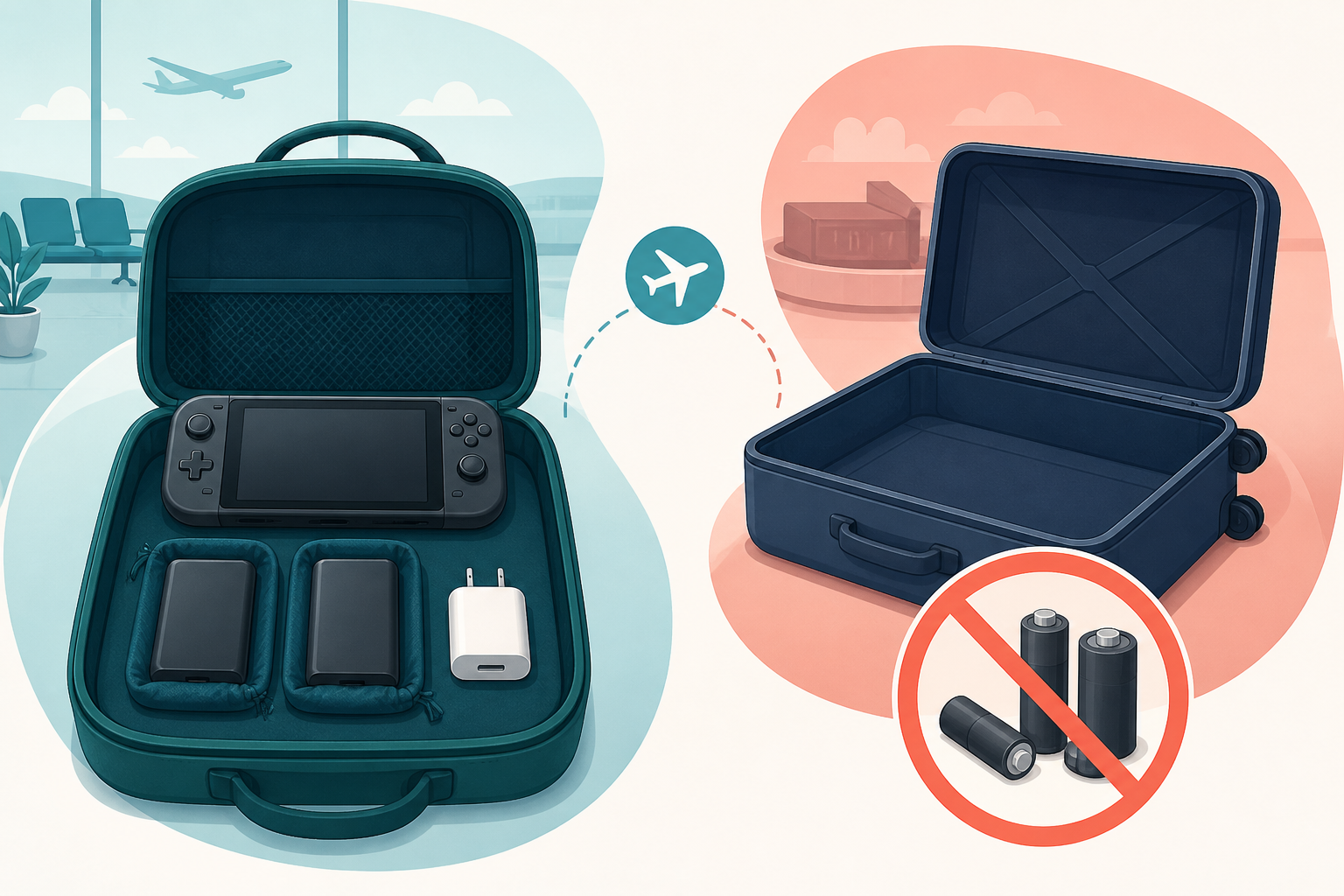
My recommendation is simple: keep the handheld, spare batteries, and power banks in your carry-on, where you can reach them. For 2026 travel, limit yourself to two power banks of no more than 100 watt-hours each, protect every loose battery from short circuits, and check your airline before leaving home. If a bag gets checked at the gate, remove those items first.
The 2026 power-bank change is real
On March 27, 2026, the International Civil Aviation Organization changed its technical instructions for power banks. The current IATA passenger guidance for 2026 translates that into a practical list: passengers are limited to two lithium-ion power banks, each no larger than 100 watt-hours, and airlines may impose tighter conditions. The guidance also says not to recharge a power bank from an aircraft outlet and not to store one in an overhead locker.
A watt-hour, written Wh, describes how much energy a battery can store. Look for that number on the battery label. If the label is missing or unreadable, do not guess at the airport. Leave the battery home or confirm its documentation with the maker and airline before the trip.
The installed battery inside a normal handheld is a portable electronic device battery, not a spare power bank. That distinction affects the details, but it does not change my packing choice. The cabin is the better place because a hot, swelling, smoking, or damaged device can be noticed and reported quickly.
Carry-on is the default, not a loophole
The FAA battery guidance for passengers allows most rechargeable devices from 0 to 100 Wh in carry-on baggage. Batteries from 101 to 160 Wh require airline approval, and anything above 160 Wh is forbidden on passenger aircraft. A typical gaming handheld may sit below those higher ranges, but read the actual label instead of treating the device category as proof.
The FAA permits a device with an installed battery in checked baggage under conditions: it must be completely powered off, protected from accidental activation, and protected from damage. Sleep mode does not count as off. I still recommend carry-on for a handheld because access is the useful safety advantage. A checked suitcase can be dropped, compressed, and buried where you cannot see a warning sign.
Spare lithium batteries and power banks are different. They cannot go in checked baggage. The FAA also says that if your carry-on is taken at the gate, you must remove portable rechargers and spare batteries and keep them with you in the cabin. That tiny boarding-area reshuffle is a poor time to discover everything is buried under three days of socks.
Pack the handheld for access and protection
Start with a fully powered-off handheld in a fitted case that protects its screen, sticks, and power button. A plain protective handheld case is useful when it keeps pressure off the controls and fits inside your personal item. Pick by measurements and padding, not by a heroic product title.
Put power banks in separate protective pouches. Do the same for a removable spare battery, or cover exposed terminals with nonconductive tape so metal objects cannot bridge them. Keep coins, keys, and loose adapters elsewhere. The goal is boring isolation. Boring is excellent when the alternative is a short circuit at 30,000 feet.
Place this battery kit near the top of the bag. If a gate agent needs to check your roller, you can lift out the handheld and battery pouch in seconds. Keep the capacity labels visible enough to show airline staff without unpacking the whole case on the floor.
Use wall power before adding another battery
My travel kit would favor a compact USB-C wall charger with a folding plug over a third power bank. It is useful for charging at the hotel or gate without adding another spare battery to the cabin count. Confirm that its output is compatible with your handheld by checking the device maker’s support page.
Do not build the plan around charging a power bank from the seat outlet. Current IATA guidance says not to do that. Airlines can also restrict using a power bank to charge another device during parts of the flight. A charged handheld, sensible brightness, and an offline game are less fussy than a cable nest under a tray table.
If battery life is the main reason you are shopping for a new device, revisit the decision points in my retro handheld buying guide. Portability includes the charger, case, and battery rules, not only the object in your hands.
Run this check before leaving home
Inspect the handheld and every battery. Do not fly with a battery that is swollen, punctured, unusually hot, leaking, or subject to a recall. The FAA’s baggage reminder says passengers should keep battery-powered devices accessible and protect them from damage and accidental activation. If a device overheats, expands, smokes, or burns during travel, notify the flight crew immediately.
Then open the airline’s own dangerous-goods page. Confirm its quantity limit, capacity rule, storage instructions, and any route-specific restriction. International rules and carrier policies can be stricter than the U.S. baseline. Save the page or take a screenshot for reference, but follow the live policy if staff gives updated instructions.
My final call: carry the handheld in a protective case, carry no more than two clearly labeled power banks under 100 Wh, protect every spare terminal, and keep the whole kit reachable. If you cannot verify a battery, do not pack it. That is a much better preflight ritual than arguing with a mystery rectangle at the gate.
Pack smart and save the boss fight for the game.
Mike, the Gamer Dude